Wolf Oven Repair
How to Install a Wolf Wall Oven Without Causing a Service Call
To install a wall oven, confirm the cutout against the installation guide, build a level base that carries its weight, bring a dedicated 240/208-volt circuit to a reachable junction box, take the doors off, slide it in with helpers and screw the trim to the cabinet sides.
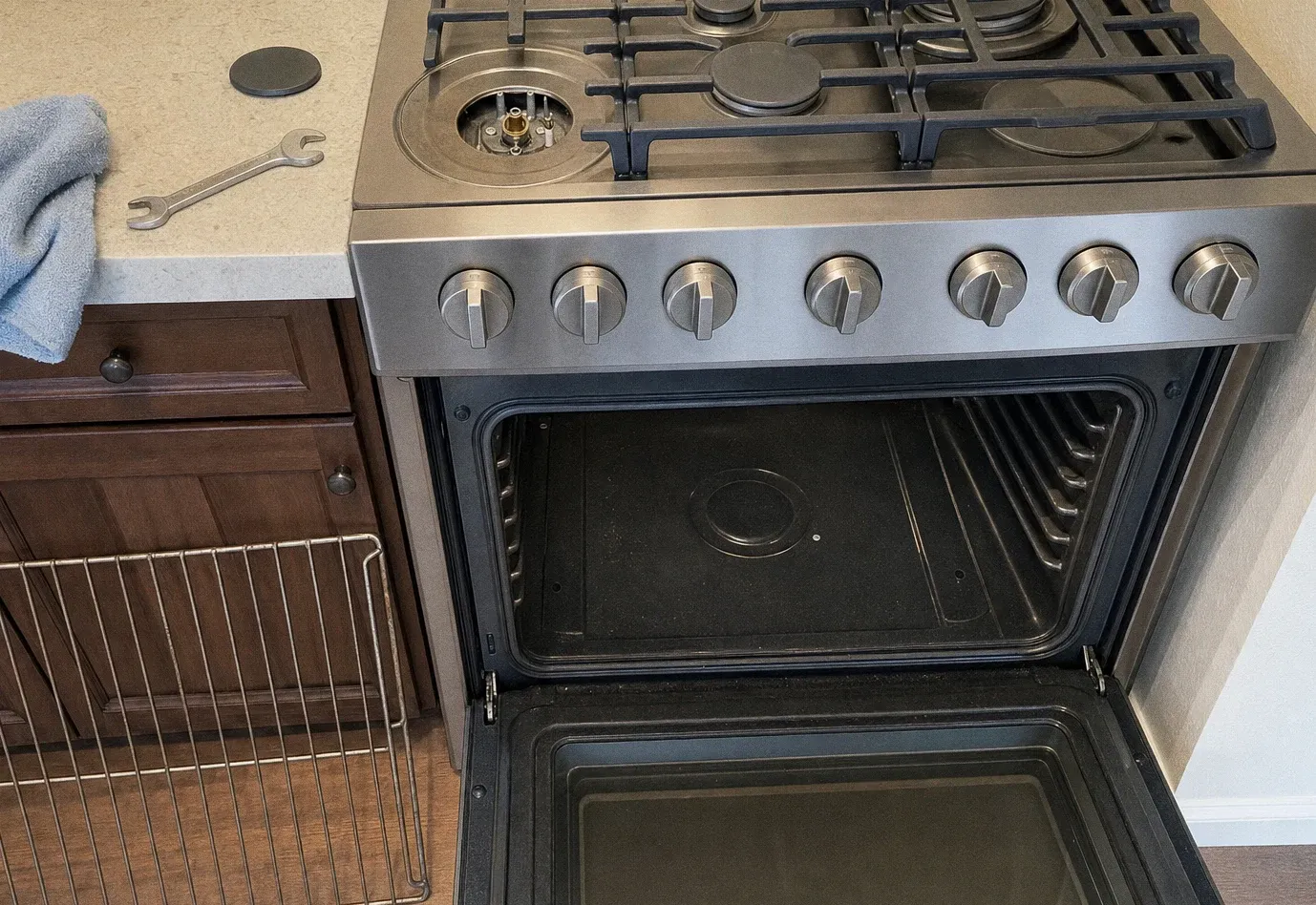
Installing a wall oven comes down to four checks made before anyone lifts it: the cutout matches the installation guide to a fraction of an inch, the base is level and strong enough for the weight, a dedicated 240/208-volt circuit ends in a junction box you can still reach, and there is room behind the oven for its conduit. After that the doors come off, two or three people slide the oven onto its base, and screws through the side trim fix it to the cabinet. Done in that order, a single oven is an afternoon’s work; a double takes longer, mostly because of the weight.
The measuring matters more than the lifting. In older Newton houses, where a kitchen may have been redone more than once, the box that held the last oven is often not the size the new one expects.
Measure the cutout before the oven arrives
Every wall oven ships with an installation guide listing a cutout width, height and depth, along with the cabinet width it assumes. Treat those numbers as minimums. An opening an eighth of an inch too narrow is not something to force: the oven frame twists, the door stops meeting its gasket evenly, and heat leaks around the edge. Measure at the top, middle and bottom, since cabinet sides are rarely perfectly parallel, and compare the two diagonals to see whether the box is square.
Depth deserves the same care as width. The back of the cutout has to leave space for the flexible conduit to loop without being pinched, and for whatever air the oven moves to cool its electronics. If a vent pipe or an old wall stud sits behind the cabinet, find it now rather than with the oven halfway in.
Height is a choice worth making on purpose. A single oven is easiest to live with when the open door lands near hip level, so a heavy roast slides out across the door instead of being hauled up from a low cavity. With a double oven the lower cavity ends up close to the floor, which is one reason some kitchens pair a single oven with a speed oven or a warming drawer instead.
Build a base that carries the weight
A double wall oven is among the heaviest objects in a kitchen, and the shelf beneath it carries all of it, plus the extra load each time a full roasting pan rests on an open door. The installation guide states whether the oven needs a solid floor in the cutout or can sit on runners, and how much that floor must hold. Plywood of the specified thickness, screwed to the cabinet frame and supported from below, is the usual answer; a thin particleboard shelf resting on pins is not.
Level the base front to back and side to side before the oven goes in. An oven that sits out of level browns unevenly from one side to the other, and its doors can drift open or shut under their own weight. Fixing that afterward means pulling the whole oven back out.
Get the power right: circuit, junction box and conduit
Wolf wall ovens are electric, so there is no gas to run, and the convection steam model fills from a reservoir, so there is no plumbing either. What each of them does need is a dedicated 240/208-volt circuit matched to the amperage on its rating plate. Do not share that circuit with a cooktop, and do not reuse an old oven’s breaker without confirming the wire gauge suits the new load. This connection is a job for an electrician, and your town may require a permit.
Place the junction box where it can be reached once the oven is in, typically in a neighboring cabinet or in the space above or below the cutout, wherever the guide directs. A box mounted squarely behind the oven forces the conduit into a tight bend and turns any later service into a removal job. Leave enough slack for the oven to slide fully home without crimping the line. A house supplied at 208 volts rather than 240 will see a slightly slower preheat; that is expected and not a fault.
Lift and set the oven
Take the doors off first. On most wall ovens the door lifts free once the hinge locks are flipped open with the door partly closed, and the guide shows the exact angle. That removes a good share of the weight and protects the hinges, which are the part most easily bent when someone grabs the oven by its door. Pull out the racks and any packing material from the cavity at the same stage.
Lay a sheet of hardboard or flattened carton on the base so the oven slides rather than scrapes, and lift with two people for a single oven and at least three for a double, or rent an appliance lift. Feed the conduit back into the cabinet as the oven moves in, watching that it does not fold under the rear edge. Push until the trim sits evenly against the cabinet face, then drive the screws through the side trim into the cabinet sides. Snug them down; overtightening can pull the trim out of line.
Rehang each door, close it slowly, and check that it meets the gasket evenly all the way around. A door that stands proud at one corner usually means a hinge that has not seated fully in its slot.
The installation mistakes that turn into repair visits
Most problems in the first weeks after an install trace back to the steps above. A conduit crushed behind the oven, or a loose connection at the junction box, can show up as dead controls, a breaker that trips, or a hot electrical smell inside the cabinet. A bent hinge or a misaligned door lets heat escape, so the outer frame runs hot and the cavity struggles to hold its set temperature; door hinge, glass or seal repairs typically fall between $210–$930, with the firm figure given after diagnosis. Trim pushed tight against a cabinet in a way that blocks the cooling vents can make the control shut the oven down to protect itself.
Before cooking, run the oven empty at a high bake setting for about an hour to burn off the manufacturing oils, with a window open. If something still seems wrong after that, Wolf Repair Newton works on wall ovens in West Newton and the surrounding villages, and our Wolf oven repair visit is a flat $95 that pays for a complete diagnosis and comes off the repair bill if you go ahead with the work. Call (617) 396-3696. If the first self-clean leaves the door stuck shut, our locked-door walkthrough covers what to check before you call.
Also asked
Can I install a double wall oven into an existing cabinet myself?
You can if the cutout, the base and the circuit already match the new oven's installation guide, and you have at least two strong helpers or an appliance lift. Most trouble comes from cabinets built around a different oven: an opening a fraction too small, a shelf that sags, or a breaker sized for the old unit. Measure all three before delivery day.
What size circuit does a wall oven need?
A wall oven needs its own 240- or 208-volt circuit, sized to the amperage printed on its rating plate and in the installation guide. Single ovens often ask for 30 amps and doubles for 40 or 50, but the plate is what counts, and an electrician should confirm that the wire gauge and breaker suit it.
Why does my new wall oven smell the first time I use it?
A mild odor over the first few heat cycles is normal, because oils from manufacturing and binders in the insulation burn away. Run the oven empty at a high bake setting with a window open. A sharp smell of hot plastic or wiring coming from the cabinet is a different matter: switch the breaker off and have the connection inspected.
Does a steam oven need a water line?
Usually not. The Wolf convection steam oven draws from a removable reservoir that you fill by hand, so it needs only power and a correct cutout. A few other makers sell plumbed versions with a drain connection, and those need supply and drain work planned before the cabinetry is finished.